DUO Portfolio Game
This article is a part of the series "xp-days-benelux-2025." Other articles in the series:
- So long, and thanks for all the fish - The farewell tour
- DUO Portfolio Game
- Whole Team Collaboration: Navigating the seven C's
On November 27 and 28, I went to the XP Days Benelux conference. This blog post is a short recap of all the things I learned.
In this second post, I’m sharing my notes and reflections from the session “DUO Portfolio Game” by Jan-Willem Zijlstra, Jeroen Smit, and Willem Kleinenberg. The session introduced a game they developed to spark conversations about culture, collaboration, and ways of working. Through several rounds, participants experienced firsthand how different strategies for distributing work across teams can shape flow, ownership, and alignment.
The goal of the session was clear: explore how teams might organize and collaborate more effectively, and discover what happens when you shift constraints, responsibilities, or communication paths.
I joined this session for a simple reason: I like games. I’ve played several “business games” before, and I was curious what this one would bring. The name DUO Portfolio Game didn’t ring a bell at first, until I learned that DUO stands for Dienst Uitvoering Onderwijs, a Dutch governmental department responsible for education.
It turns out DUO developed this game as a learning tool for portfolio management. The idea is to explore different ways of organizing work and immediately see the impact of your decisions. By experimenting with strategies like focusing on value streams, improving knowledge sharing, or fostering better collaboration, you quickly begin to understand how structure influences flow.
The game turned out to be surprisingly insightful, and with a few small tweaks, it could easily be adapted for use in other organizations as well. Unfortunately, the Dutch government doesn’t do open source, so if I ever want something like this for my own teams… I may have to build it from scratch.
The Game
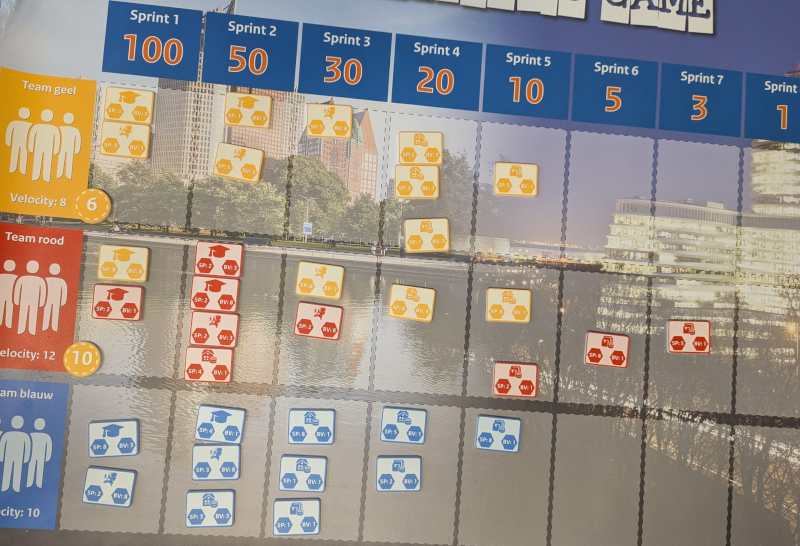
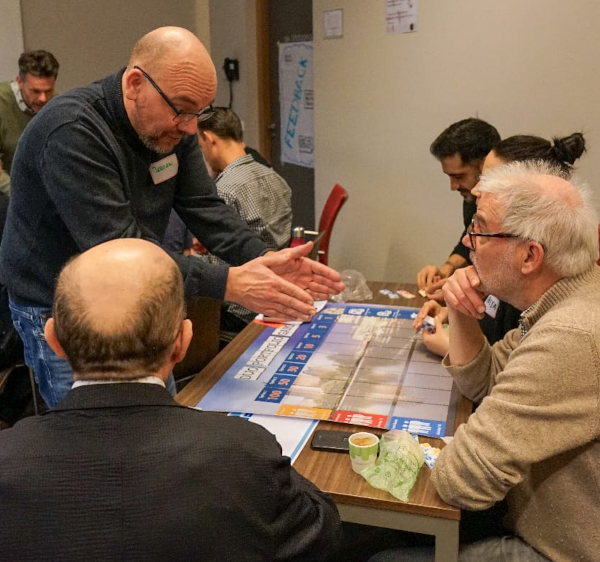
The mechanics were simple: three teams, four products, a few rounds with shifting constraints. After each round, we compared scores with the other tables and ran a short retrospective. Each round had a different objective, which required a different strategy. For example, in the second round the goal was simply to maximize outcomes.
One of the biggest insights came from observing what happens when teams invest in sharing knowledge. Collaboration and cross-training slow teams down in the short term, but the overall flow can still improve dramatically.
In one scenario, the red team had a lower velocity because it spent time teaching the yellow team. That investment paid off: the red team could now take on yellow work whenever needed. The yellow team also slowed down slightly for the same reason, but because red could support them, the system as a whole performed better.
It’s a great reminder: optimizing individual teams doesn’t always optimize the organization. Sometimes you need to deliberately slow down in order to go faster together.
I really enjoyed playing this game. It sparked good conversations about strategy, expectations, and what “optimizing” even means. I’m already thinking about creating a similar game tailored to my own company’s domains and challenges. I think it could be a powerful way to inspire meaningful change.