So long, and thanks for all the fish - The farewell tour
This article is a part of the series "xp-days-benelux-2025." Other articles in the series:
- So long, and thanks for all the fish - The farewell tour
- DUO Portfolio Game
- Whole Team Collaboration: Navigating the seven C's
On November 27 and 28, I went to the XP Days Benelux conference. This blog post is a short recap of all the things I learned.
In this first post, I’m sharing my notes and reflections from the session “So Long, and thanks for all the fish - The farewell tour" by Ron Eringa, Paul Kuijten, and Dajo Breddels. The session explored the question of whether the Agile movement has run its course: been there, done that, got the T-shirt. With the Agile label losing some of its shine, the facilitators invited us to properly say goodbye to what no longer serves us, and to salvage the practices and principles still worth keeping.
The goal of the session was simple but important: take stock. Is Agile dead? And if not, how do we move forward?
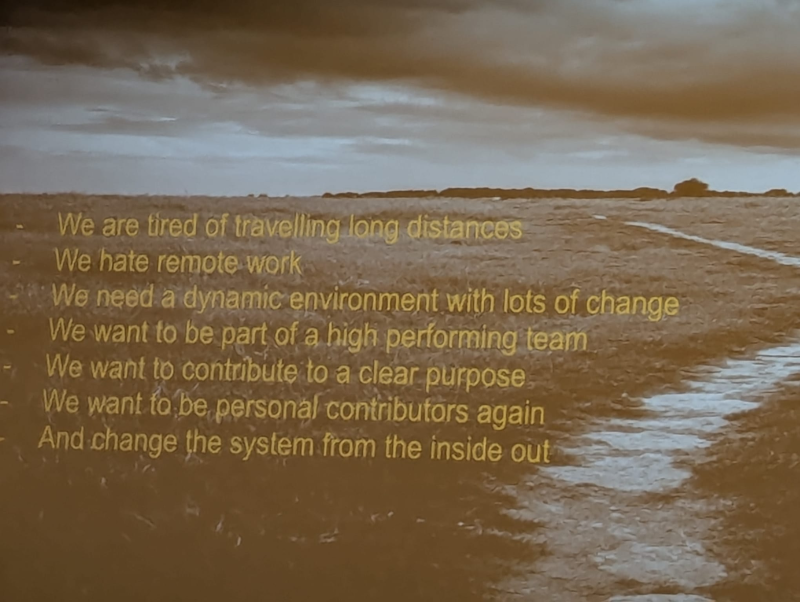
The room was packed, every seats taken. I walked in, not really knowing what to expect; the session description had been a bit vague, and the three presenters seemd to be freestyling their way into the topic. But that didn’t make it a bad session. Quite the opossite. The energy was high, and the interaction between speakers and audience made it ont of the more thought-provoking part or the program.
One line stuck with me:
Agile isn’t dead. Agile won. But do we like the way it looks?
And honestly… that hit home.
Because if we don’t like what Agile has become in some organizations, the question isn’t wether Agile failed, but what we need to do to make it better.
My personal take-away: I have strong opinions about Scrum. I have frameworks I prefer, practices I advocate for, and things I’m convinced are broken. But this session reminded me to stay humble:
Why do I believe my perspective is better? Am I helping others validate their beliefs but forgetting to validate my own?
Maybe Agile and Scrum have become cargo-cults in some places. Maybe I’ve been right to call that out. But that doesn’t mean my own beliefs are immune to stagnation or dogma.
Cargo Cult?
During World War II, the United States operated airbases on several islands in the South Pacific. Supply planes arrived regularly, bringing cargo filled with medicine, food, tools, weapons, items the islanders had never seen before. When the war ended, the military left, and the planes stopped coming.
In response, some islanders began building what we now call a cargo cult: they constructed imitation runways, bamboo control towers, wooden headphones, and even model airplanes. They copied the rituals and ceremonies they had observed the soldiers perform, marching, saluting, lighting fires along the “runway”, hoping the planes would return with their life-changing cargo.
Of course, the planes never came back. They had copied the visible actions, but not the underlying system that made those actions meaningful.
The parallel with Agile transformations is hard to ignore. We imitate the ceremonies, adopt the roles, and schedule the stand-ups. We create backlogs, conduct retros, and memorize the textbook practices. But without deeply understanding why these practices exist and what conditions must be in place for them to work, we fall into the same trap: the rituals happen, but the results don’t.
Instead of going deeper, examining organizational constraints, culture, leadership, flow, and real customer impact, we cling to the surface-level behavior, hoping that eventually the “Agile cargo” will arrive. The lesson is simple but uncomfortable: copying is not the same as transforming.
Further Reading & Resources
These are the books, resources, and topics that came up during the session, or that it reminded me of, and that I want to explore further.
- XP Days Benelux
- Spiral Dynamics
- Beyond Budgeting